

Whether you’re trekking through the rice terraces of Sapa, scaling Mount Rinjani in Lombok, or tackling the Annapurna Circuit in Nepal, hiking has become one of the most popular ways Singaporeans explore the world.
But here’s a question many travellers only ask after something goes wrong: Is there travel insurance for hiking?
The short answer is: it depends. A simple day hike and a high-altitude trek are not always treated the same way, and that difference can matter when it comes to claims.
Here’s everything you need to know about hiking insurance.
Key Takeaways
- Hiking cover is not automatically the same across all travel insurance policies.
- Some lower-risk hiking may be treated differently from trekking, mountaineering, or technical climbs.
- Under HLAS Travel Protect360, trekking at 3,000 metres above sea level, mountaineering, and certain forms of rock climbing are specifically excluded.
- The most important things to check are medical cover, emergency medical evacuation, trip cancellation or curtailment, baggage or sports equipment terms, and 24/7 emergency assistance.
- If your itinerary involves altitude, remote terrain, or specialised gear, don’t rely on assumptions — check the policy wording first.
Does Regular Travel Insurance Cover Hiking?
Sometimes, yes — but not always in the way travellers expect.
Many people assume that if they’ve bought travel insurance, hiking is automatically included. That may be true for some lower-risk activities under some policies, but insurers often draw a line once an activity involves higher altitude, more difficult terrain, technical elements, or what they classify as adventure travel.
That’s why it’s better to think in terms of “What exactly am I doing on this trip?” rather than simply “Am I hiking?”
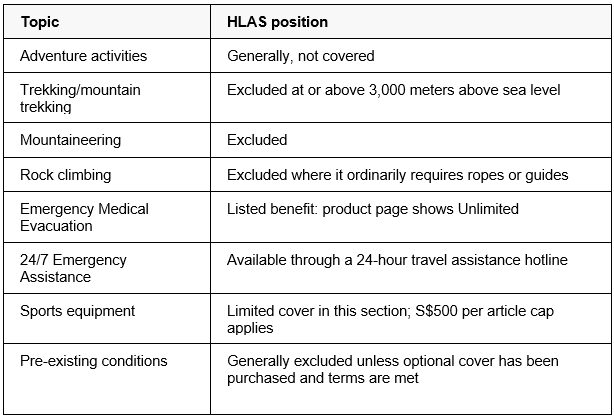
For HLAS Travel Protect360, adventure activities are not covered, and the policy wording goes further by naming exclusions such as trekking at or above 3,000 metres above sea level, mountaineering, and rock climbing that ordinarily require ropes or guides.
What Hiking Holiday Insurance Should Really Cover
When you’re comparing hiking trip policies, it helps to focus on the parts that matter most in real life.
- Emergency Medical Expenses – If you’re injured overseas, treatment costs can escalate quickly, especially if you’re far from major medical facilities. Know whether your planned activity falls within coverage in the first place.
- Emergency Medical Evacuation – If you’re trekking in a remote area or mountainous region, getting proper medical help may mean arranging transport to another facility.
- Trip Cancellation Or Curtailment – If you have to cancel your trip before departure or cut it short after it starts because of a covered reason, these benefits can be important.
- Baggage and Sports Equipment – If you travel with hiking gear, don’t assume all loss or damage is automatically covered.
- 24/7 Emergency Help – When you’re overseas, especially in a stressful situation, being able to call for assistance matters. Check whether your travel insurance includes 24-hour Travel, Emergency Medical and Evacuation Assistance, available 24/7 through its hotline.
The Altitude Question: What Happens When You Hike Higher?

Altitude is one of the easiest details to overlook — and one of the most important.
A route may sound like “just a trek,” but once it reaches a certain elevation, the insurance coverage can change. Under HLAS Travel Protect360, trekking (including mountain trekking) at or above 3,000 metres above sea level is specifically excluded.
That means if you are planning a route with any meaningful elevation, it’s worth confirming exactly how high the trek goes and whether that crosses the insurer’s threshold.
Tip: If altitude is part of the trip, ask the insurer directly and keep the response in writing.
What HLAS Travel Protect360 Says About Hiking-Related Risks
To clarify, here’s how some key hiking-related issues are handled under HLAS Travel Protect360.
3 Hiking Insurance Myths That Could Cost You
At HL Assurance, we’ve seen many travellers caught off guard by misunderstandings around hiking coverage. So, here are the most common myths to help you avoid the same costly mistakes.
Myth 1: “I bought travel insurance, so I’m covered for my trek.” Standard travel insurance doesn’t automatically cover all hiking activities. The type of hike, altitude, and equipment involved all affect whether your claim will be approved.
Myth 2: “It’s just a short trip — I don’t really need insurance.” Emergency helicopter evacuations from mountainous terrain can cost tens of thousands of dollars. A short trip doesn’t mean a small risk.
Myth 3: “All insurers offer the same hiking coverage.” Coverage can vary significantly between providers — from altitude limits to what counts as “adventure sports.” Reading the fine print isn’t optional; it’s essential.
Before You Book That Trek: A Pre-Trip Checklist for Hikers
Getting the right insurance is only part of the equation. Here’s what smart hikers do before they head out:
- Research the trail — know the difficulty rating, terrain, and altitude profile
- Check travel advisories — the Singapore Ministry of Foreign Affairs issues destination-specific warnings that can affect your coverage
- Disclose everything to your insurer — pre-existing conditions, planned activities, and destinations
- Save your insurer’s emergency hotline — not just the policy number, the actual contact you call in a crisis
- Inform someone at home of your itinerary and check-in schedule
What to Do If You’re Injured on the Trail
If something goes wrong mid-hike:
- Prioritise safety first — stop hiking and assess the situation
- Contact your insurer’s 24/7 emergency line immediately; do not arrange evacuation independently if possible, as this could affect your claim
- Document everything — photos, medical reports, receipts
- Keep all records of treatment received, including at local clinics, before evacuation
Trying to manage an emergency on your own and claiming later is riskier than calling your insurer first. Most insurers with strong travel policies — like HLAS Travel Protect360 — offer round-the-clock emergency assistance to help coordinate your care from the moment you call.
Travel Insurance Hiking Coverage: Travel Smart, Hike Safer
Hiking holiday insurance isn’t always straightforward. Coverage can vary depending on the type of trek, altitude, and activities involved. As this guide shows, even standard travel insurance may exclude higher-risk hikes, so understanding your policy before you travel is essential.
The safest approach is not to just ask whether a policy includes travel insurance for hiking in general. Ask whether your specific route, altitude, and activity type are covered under the policy wording.
At HL Assurance, we’ve seen how easily travellers get caught out by assumptions around hiking coverage, which is why we emphasise clear, activity-specific protection and reliable emergency support when it matters most.
If hiking is part of your next trip, explore HL Assurance’s Travel Protect360 insurance or reach out to our service team at service@hlas.com.sg or +65 6702 0202 to find a plan to make sure you’re properly covered before you set off.
=====
Frequently Asked Questions
What should I look for in hiking holiday insurance?
Look for clear wording around trekking or hiking, altitude exclusions, emergency medical evacuation, overseas medical expenses, baggage or gear terms, and access to 24/7 emergency assistance.
Are there exclusions I should be aware of?
Yes. For HLAS, some key hiking exclusions include trekking at 3,000 metres above sea level, mountaineering, and rope- or guide-dependent rock climbing. Pre-existing conditions are also generally excluded unless optional cover has been purchased and the relevant terms are met.
Can I claim for lost hiking gear?
Possibly, but don’t assume full cover. Under HLAS Travel Protect360, sports equipment may be covered under the baggage and personal effects section in limited circumstances, with a S$500 per article limit.
Why is emergency medical evacuation so important for hiking trips?
Because medical help is not always nearby. If you’re in a remote or mountainous area, evacuation can be one of the most important parts of the policy. HLAS lists Emergency Medical Evacuation as a benefit and also offers 24/7 emergency assistance through its hotline.
=====
Author Bio:
HL Assurance (HLAS) is a licensed general direct insurer in Singapore and a member of the General Insurance Association (GIA). Backed by the Hong Leong Group — a diversified conglomerate spanning banking, financial services, and investments across Asia, Europe, and beyond — HLAS offers a wide range of personal and commercial insurance products, including travel, motor, home, maid, and personal accident insurance. With a track record of award-winning service and a focus on digital accessibility, HLAS is dedicated to helping individuals and businesses in Singapore protect what matters most.





 Malaysia
 Hong Kong