

A sudden hospital stay rarely waits for a convenient time. Between missed workdays, childcare gaps, and bills that keep arriving, the financial strain can outlast the illness itself.
At HL Assurance, we have helped many Singaporeans plan for exactly this kind of disruption, and this guide breaks down when hospital income insurance genuinely earns its place in your protection plan.
Key Takeaways
- Hospital income insurance pays you a fixed cash amount for each day you are hospitalised, regardless of your actual medical bill
- It works alongside MediShield Life and Integrated Shield Plans rather than replacing them
- It matters most if you are self-employed, a sole breadwinner, or have limited paid medical leave
- Premiums are generally affordable, but the value depends on your existing savings and coverage gaps
What Hospital Income Insurance Actually Covers
Hospital income insurance is not the same as your Integrated Shield Plan. Shield plans reimburse your actual hospital bill. Hospital income insurance instead pays you a fixed daily cash benefit simply because you were admitted, on top of whatever your other policies already cover.
With HL Assurance’s Hospital Protect360, for example, you can receive a daily hospital cash benefit of up to S$300, with a triple payout of up to S$900 per day if you are warded in the ICU for up to 30 days, plus a recuperation benefit once you are discharged and recovering at home.
There is no need to submit receipts proving how the money was spent. Whether it goes towards your mortgage, your children’s school fees, or simply replacing the income you lose while away from work, the choice is yours.
This is precisely the gap many Singaporeans overlook. MediShield Life and private shield plans settle the hospital’s invoice, but they were never designed to cover your rent, your maid’s salary, or your business’s overheads while you recover.
Why the Gap Matters More Than You Think
Singapore’s healthcare financing is layered for a reason.
- MediShield Life forms the base, subsidising large bills in public hospitals.
- Integrated Shield Plans build on that, extending cover to private hospitals and higher ward classes.
Neither layer, however, accounts for the income disruption caused by hospitalisation.
Consider the difference in ward costs. A subsidised public hospital stay in a Class C ward costs around S$53 per day at admission, against around S$619 for an unsubsidised single-bed Class A room at a restructured hospital, according to the Ministry of Health. Private hospital daily ward charges typically run higher again.
Even with comprehensive medical coverage, the indirect costs (lost freelance income, a caregiver taking unpaid leave, daily transport for family visits) fall entirely outside what a shield plan reimburses. This is where a daily cash benefit fills a real and often underestimated gap.
Who Should Seriously Consider It
Hospital income insurance is not essential for everyone, but it becomes considerably more valuable for certain groups.
| Profile | Why it matters |
|---|---|
| Self-employed or freelance | No employer-paid medical leave; income stops the moment you do |
| Sole breadwinner | Household expenses continue regardless of hospitalisation |
| Limited emergency savings | A short hospital stay could disrupt monthly cash flow |
| Parents with young dependents | School fees, childcare and daily costs do not pause |
| Frequent private hospital users | Indirect costs scale with ward class and length of stay |
If you have substantial savings, comprehensive employer benefits, and minimal financial dependents, the case for this coverage is weaker, though many still view it as a low-cost way to protect their emergency fund from being drawn down unnecessarily.
How Much It Typically Costs in Singapore
Premiums vary by insurer, plan tier, and your age, but hospital income plans are generally one of the more accessible additions to a protection portfolio. Coverage tiers usually scale the daily benefit, the ICU multiplier, and the recuperation payout together, so it is worth matching the tier to your actual monthly obligations rather than simply picking the cheapest option.
It is also worth checking whether your insurer offers a reward for a claims-free year. HL Assurance’s Hospital Protect360, for instance, returns a percentage of your premium if you make no claims within a policy year, which can meaningfully offset the long-term cost of staying covered.
What to Check Before You Buy
A few details separate a genuinely useful policy from one that disappoints when you need it most.
- Waiting periods. Most hospital income plans impose a waiting period for illness-related claims, often around 30 days from your policy start date, though accident-related claims are typically covered from day one.
- Claim coordination. Confirm whether the daily cash benefit pays out independently of your Shield Plan or MediShield Life claim. With most genuine hospital income products, it does, meaning you are not penalised for already being well covered medically.
- Definition of hospitalisation. Some plans exclude community hospitals, rehabilitation centres, or day surgery from their definition of an eligible hospital stay. Read this carefully if you anticipate step-down care.
- Coverage while overseas. If you travel frequently for work or have family abroad, check the overseas coverage period, as this varies significantly between insurers.
- Exclusions. Pre-existing conditions, certain elective procedures, and treatment received outside the policy’s defined waiting period are commonly excluded. A quick read of the policy’s exclusion list before signing saves confusion later.
For families specifically, it is also worth looking at broader personal accident coverage.
Our Family Protect360 plan, for example, bundles income protection-style benefits with accident medical expense cover and infectious disease protection, which some households find more efficient than purchasing hospital income cover as a standalone product.
Hospital Income Insurance vs Your Other Policies
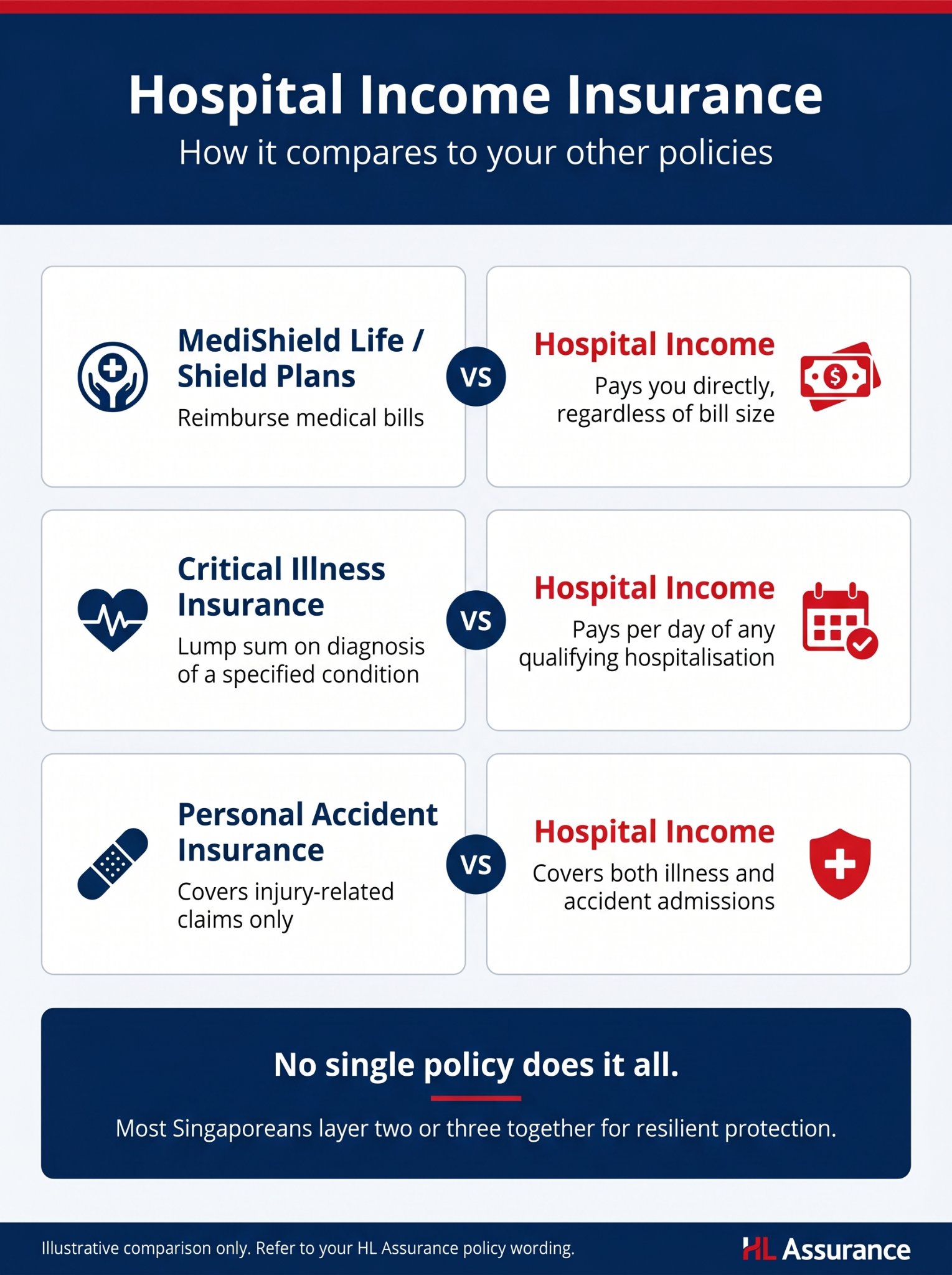
It helps to see where this coverage sits relative to what you may already own.
- MediShield Life and Shield Plans reimburse medical bills. Hospital income insurance pays you directly, regardless of the bill size.
- Critical illness insurance pays a lump sum on diagnosis of a specified serious condition. Hospital income insurance pays per day of any qualifying hospitalisation, serious or not.
- Personal accident insurance covers injury-related claims, often without an illness component. Hospital income insurance typically covers both illness and accident admissions.
None of these products fully substitutes for the others. Most Singaporeans who build a resilient protection plan layer two or three of them together, rather than relying on a single policy to do everything.
Why Hospital Income Insurance Deserves a Place in Your Coverage
For self-employed individuals, sole breadwinners, and parents with ongoing commitments, hospital income insurance fills a gap medical insurance doesn’t: lost income while you recover. Premiums are modest relative to the daily benefit.
Those with strong savings and employer benefits may see it as supplementary, but many still choose it to protect their emergency fund rather than draw it down. The right call depends on your income, existing coverage, and how exposed your household would be if hospitalisation were to strike this month.
At HL Assurance, we offer daily cash benefits, ICU enhancement, and a recuperation payout, so a hospital stay affects your recovery, not your finances.
When in doubt, you can chat with HLAS to find out more. Reach our service hotline at 6702 0202 or email service@hlas.com.sg.
Frequently Asked Questions
Can I have more than one hospital income insurance policy at the same time?
Yes, you can hold multiple hospital income policies from different insurers, and most will pay out independently of each other. However, check each policy’s terms, as some insurers cap the combined daily benefit payable across policies.
Does hospital income insurance cover mental health hospitalisation?
This varies by insurer. Some plans cover psychiatric hospitalisation under standard terms, while others exclude it or apply different limits. Always confirm this specifically if it is relevant to your situation.
Will my premium increase every year?
Most hospital income plans use age-banded premiums, meaning your premium rises as you move into a new age bracket at renewal, rather than increasing every single year. Always check whether your plan is age-banded or has level premiums.
Can children be covered under a hospital income insurance policy?
Yes, most insurers allow you to add dependent children to a family or individual plan, often up to a specified age limit or until they finish full-time studies.
What happens to my hospital income policy if I become unemployed?
Hospital income insurance is typically tied to the policyholder, not employment status, so coverage continues as long as premiums are paid. It is one of the few protections that does not lapse simply because your job situation changes.
About HL Assurance
HL Assurance (HLAS) is a licensed general direct insurer in Singapore and a member of the General Insurance Association (GIA). Backed by the Hong Leong Group, a diversified conglomerate spanning banking, financial services, and investments across Asia, Europe, and beyond, HLAS offers a wide range of personal and commercial insurance products, including travel, motor, home, maid, and personal accident insurance. With a track record of award-winning service and a focus on digital accessibility, HLAS is dedicated to helping individuals and businesses in Singapore protect what matters most.

 Malaysia
 Hong Kong