

Most drivers only think about insurance after something goes wrong. At HL Assurance, we have seen firsthand how confusing third-party car insurance can be, especially when policy terms read more like legal contracts than practical advice.
This guide focuses on how to choose 3rd-party car insurance that genuinely suits you, who it works best for, and how the buying process actually works.
Key Takeaways
- Third-party car insurance is the legal minimum required to drive in Singapore and covers damage or injury you cause to others.
- It does not cover your own vehicle unless you add fire and theft protection or upgrade to comprehensive cover.
- Whether third-party cover suits you depends on your car’s value, your financial buffer, and how often you drive.
- You can buy car insurance online in minutes, often at a lower cost than going through an agent.
What is Third-Party Car Insurance?
Third-party car insurance, often referred to as Third Party Only (TPO) or “Act only” cover, sits at the entry level of motor insurance in Singapore. It is also the single tier of coverage that drivers are legally obligated to carry. Rather than protecting your own car, this policy protects other people, the “third parties”, from financial loss if you are at fault in an accident.
This means that if you hit another vehicle, injure a pedestrian, or damage someone’s property while driving, third-party insurance covers their losses. Your own car repairs, however, are entirely your responsibility unless you have additional cover.
For a closer look at exactly what is and is not covered, including coverage limits and real claim scenarios, see our guide on third party insurance coverage.
How It Compares to Other Coverage Levels
Singapore drivers typically choose between three tiers of motor insurance, and understanding the difference helps you avoid paying for protection you do not need or skipping cover you do.
| Coverage Type | Covers Third Party Liability | Covers Fire and Theft | Covers Own Accident Damage |
|---|---|---|---|
| Third Party Only | Yes | No | No |
| Third Party, Fire & Theft | Yes | Yes | No |
| Comprehensive | Yes | Yes | Yes |
Third Party, Fire and Theft (TPFT) sits between the two extremes, adding protection against your car being stolen or damaged by fire, but it still will not pay for accident repairs to your own vehicle.
Comprehensive cover, which we offer through our Car Protect360 plan, includes everything above, plus accident damage, medical expenses, and additional benefits such as a daily transport allowance during repairs.
A Quick Recap: What’s Covered and What Isn’t
In short, third-party policies generally cover bodily injury or death to third parties (typically unlimited under Singapore’s Motor Vehicles (Third-Party Risks and Compensation) Act 1960), property damage to third parties (usually subject to a policy limit), and legal defence costs if you are taken to court over a claim.
They do not cover damage to your own vehicle, theft or fire damage to your car, or your own medical expenses, and claims are typically void for driving under the influence, without a valid licence, or for wilful damage.
Who Should Consider Third-Party Insurance?
By law, every vehicle owner driving in Singapore must hold at least third-party insurance to register or renew their vehicle, as required by the Land Transport Authority. Beyond the legal requirement, third-party cover tends to suit a specific group of drivers, including:
- owners of older vehicles nearing the end of their Certificate of Entitlement, where repair costs may exceed the car’s market value
- experienced drivers are comfortable taking on the risk of paying for their own repairs
- those who drive infrequently or mainly on quieter roads with a lower risk of accidents.
On the other hand, owners of newer or higher-value cars, less experienced drivers, or anyone who cannot comfortably absorb a large repair bill may find that TPFT or comprehensive cover offers better peace of mind, often for a smaller premium difference than expected.
A Real-World Example: Weighing Up the Decision
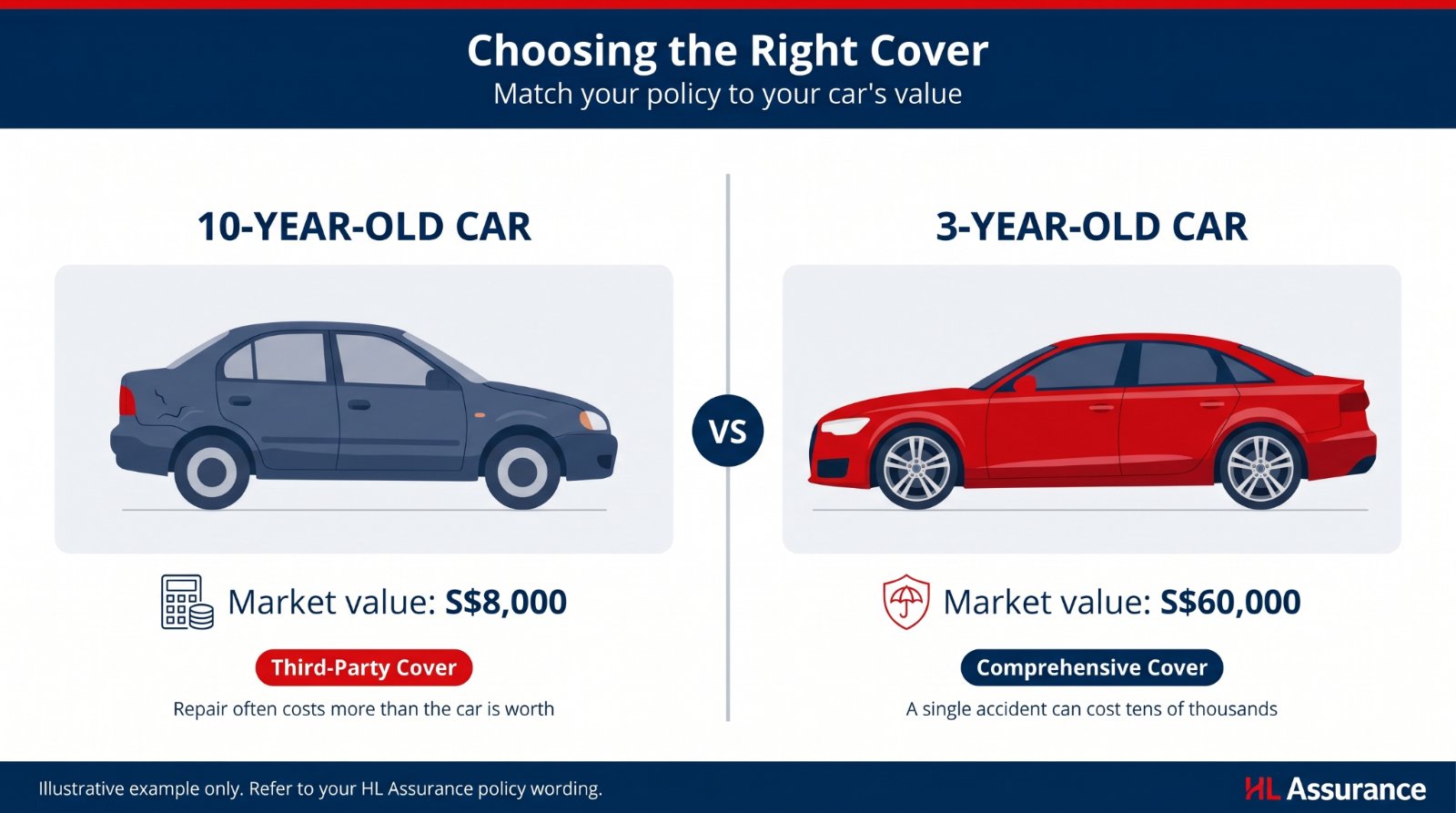
Consider a driver with a ten-year-old car nearing the end of its Certificate of Entitlement, worth perhaps S$8,000 on the resale market. Comprehensive cover for this car might cost a few hundred dollars more per year than third-party-only cover.
Given the car’s low market value, even a moderately serious accident would likely cost more to repair than the car is worth, so the driver decides that third-party cover makes financial sense, accepting that a written-off car will simply be replaced rather than repaired.
Compare this to a driver with a three-year-old car worth S$60,000. Here, the maths flips. A single accident could easily cost tens of thousands in repairs, far outweighing the modest premium saved by skipping comprehensive cover. This is the kind of comparison worth running before deciding which cover tier fits your situation.
How to Choose the Right Coverage
Before settling on a policy, it helps to assess a few practical factors.
- Your car’s value. If repair costs could easily exceed your car’s value, third-party cover may be sufficient. As a rough rule of thumb, the closer your car is to the end of its COE or the lower its resale value, the more third-party cover starts to make financial sense.
- Your financial buffer. Ask yourself honestly whether you could pay a S$5,000-S$15,000 repair bill out of pocket without major disruption. If the answer is no, the extra premium for comprehensive cover is usually a worthwhile trade-off.
- Your driving environment. Frequent driving in congested areas, on expressways during peak hours, or on unfamiliar roads carries a higher risk of accidents than occasional weekend trips on quiet roads.
- Claim settlement. A lower premium means little if claims are slow or difficult to process, so it is worth checking an insurer’s service track record and claims turnaround time, not just price.
- Bundled vs. extra costs. Some insurers include benefits like roadside assistance or a transport allowance as standard, while others charge for these separately, which can change the real value of a seemingly cheaper plan.
Comparing a few quotes side by side, rather than defaulting to the cheapest option, usually gives a clearer picture of genuine value.
Buying Car Insurance Online
These days, you can buy car insurance online in just a few steps, without needing to speak to an agent. At HL Assurance, our online platform lets you enter your vehicle details, compare coverage options, and get an instant quote, often at a more competitive rate than traditional channels due to lower administrative overheads.
Once you are happy with your selection, payment and policy issuance happen digitally, with your documents sent straight to your inbox.
Choosing 3rd Party Car Insurance That Actually Fits Your Needs
Third-party car insurance forms the legal foundation of motor insurance in Singapore, protecting others from the financial impact of accidents you cause. While it is the most affordable option, it leaves your own vehicle unprotected, which makes it best suited to specific situations rather than a one-size-fits-all solution.
At HL Assurance, we believe that understanding your own driving habits, your car’s value, and your financial comfort will help you choose a policy that genuinely fits your needs. Whether that is a straightforward third-party plan or fuller protection, you can buy car insurance online and compare your options in minutes.
When in doubt, you can chat with HLAS to find out more. Reach us at 6702 0202 or email service@hlas.com.sg.
Frequently Asked Questions
Can I upgrade from third-party to comprehensive cover mid-policy?
This depends on the insurer, but many allow you to upgrade at renewal rather than mid-term. It is best to check directly with your provider.
Does third-party insurance cover passengers in my own car?
Generally no, unless you have purchased additional personal accident or medical expense cover, as standard third-party policies focus on protecting other parties, not your own vehicle’s occupants.
Will my premium be cheaper if I have a clean driving record?
Yes, a No Claim Discount typically applies after consecutive years without a claim and can meaningfully reduce your premium, regardless of coverage type.
What happens if the other party disputes fault?
Your insurer will typically investigate the accident, often using police reports and evidence from both parties, before determining liability and settlement.
Is third-party insurance valid if I drive overseas, such as into Malaysia?
Coverage outside Singapore varies by insurer and policy, so always confirm cross-border coverage before travelling.
About HL Assurance
HL Assurance (HLAS) is a licensed general direct insurer in Singapore and a member of the General Insurance Association (GIA). Backed by the Hong Leong Group, a diversified conglomerate spanning banking, financial services, and investments across Asia, Europe, and beyond, HLAS offers a wide range of personal and commercial insurance products, including travel, motor, home, maid, and personal accident insurance. With a track record of award-winning service and a focus on digital accessibility, HLAS is dedicated to helping individuals and businesses in Singapore protect what matters most.




 Malaysia
 Hong Kong